The text that follows is born of concrete theological experiences, rooted in contexts of fracture, dialogue and hope, as well as a long itinerary of research, interdisciplinary and inter-religious confrontation. It is the result of patient work at the crossroads of academic reflection, ecclesial commitment and the contemporary challenges of justice, violence and coexistence between traditions.
It is offered in the form of a manifesto to all those who are sensitive to the question of mercy and wish to become involved – at various levels – in the process it aims to open up. In keeping with the very etymology of the term manifestoThe aim is to make certain fundamental intuitions visible, to clarify theoretical achievements and to formulate guidelines for the development of a theology of mercy.
This text does not claim to be exhaustive or exhaustive. On the contrary, it presents itself as a starting point: a space for intelligibility and dialogue, offered to the Churches, the academic world and all those involved in interreligious and cultural dialogue. It aims to encourage a reconfiguration of theological discourse based on the category of mercy, understood not as a peripheral theme, but as a central hermeneutical principle capable of renewing anthropology, the theology of religions and the understanding of human and divine relations.
In this sense, this manifesto is deliberately open and dynamic, like the process it seeks to inspire. It calls for co-elaboration, a plurality of voices and shared responsibility. For proposing a theology of mercy implies a commitment: that of contributing to weaving relationships, opening up spaces of mutual recognition and promoting practices of justice and peace in contexts marked by fragmentation.
Theologians therefore have a responsibility to initiate and support reflection that is not only speculative, but also performative: a theology capable of generating links, transforming imaginations and participating, in its own way, in the construction of a common horizon where mercy becomes a principle of coexistence and a promise of hope.
Theological manifesto
Mercy as a theology of hope
“The theology of mercy is a theology of hope.
Without doubt, this is the time for the Church to rediscover its sense of mission.”
(Pope Francis)
Introduction
In a world beset by multiple crises – social, political, ecological, spiritual and even warlike – mercy is not an emotional way out, but a transformative force. It is God’s response to humanity’s misery, and a call to all people to humanize the way they see, act and think. It is the only possible way to live together in peace.
This manifesto sets out to lay the foundations for a theology of mercy as a theology of hopeemphasizing its anthropological, inter-religious and doctrinal significance.
I. An open-eyed anthropology: mercy as a spirituality of reality
Throughout the centuries, mercy – from the Latin miser (misery) and cor (heart) – retains its subversive character. It upsets, it brings, it transforms. By making us “close” to the wretched, it opens our eyes to reality as it is, unvarnished and unmythologized. Mercy is thus a theology of open eyes.
It unites justice (tsedeqa, din) and love (rahamim, hesed) in a dynamic that engages and transfigures people, relationships and communities. It restores equal dignity, expands fraternity and unifies humanity.
But this requires an inner struggle:
Ignoring the suffering of others is easy. Seeing it for real is painful. Until the suffering face becomes a living presence for us.
It is this benevolent lucidity, this refusal to look away, that is the foundation of true spirituality. Conversely, trivialization is a fatal disease for religions.
“I was hungry and thirsty… you saw me and came to help me.” (cf. Mt 25)
On Mercy seals a covenant with Reality. It makes faith, religions and institutions credible. It calls not for passive pity, but for active, structured solidarity in the face of the crisis. three forms of misery :
It educates through witness and prevents legalistic drift. For without mercy, justice becomes inhuman: summum ius, summa iniuria. Recognition of dignity is the first right, and mercy is the key: justice re-establishes the right, mercy re-establishes dignity.
Through a phenomenological and hermeneutical approacha theology rooted in reality can emerge, provided we think in the tension between justice and mercy – not to oppose them, but to make them dialogue: justice becomes restorative, mercy corrective.
II. Interreligious inspiration: towards a koinè of justice and mercy
The dialectic between justice and mercy is not unique to Christianity. It runs through religious traditions and world wisdom. In their own languages, cultures and systems of interpretation, they all implement this fruitful dialogue in the service of human dignity and fraternity.
The Hebrew traditions (hesed, rahamim), Greek (eleos, oiktirmos), and Latin (misericordia) express a spiritual convergence. The Vulgate coined an all-encompassing term for it, a synthesis of divine attributes.
The dialogue between the world’s traditions on justice and mercy is today becoming a criterion for criterion for discernment in the face of history and its ambiguities (cf. Pope Francis’ speech in Naples, 2019 ; Video message to the Faculty of Theology in Palermo, 2024).
Interreligious dialogue must work towards a polyphonic language polyphonic languagemade up of narratives that are distinct but not antagonistic, in order to found a new koinè (common space) of speech and action in favor of human brotherhood.
Founding texts such as the Abu Dhabi Document and the reflections of the Dicastery for Interreligious Dialogue show the way towards convergence in the service of peace.
III. A reformulation of theology based on mercy
“Mercy is not just a pastoral attitude, but the very substance of the Gospel of Jesus.” (Pope Francis, Letter to the University of Buenos Aires, 2015)
Mercy is a theological principle, not a mere pastoral or devotional accessory. It becomes the very place where God and reality are revealed. This is why a reform of theological thinking is needed:
This theology is called to live on borders between faith and cultures, between the Gospel and the needs of the people, between hope and real-life conflicts. It implies constant learning about humanity, in a dynamic of ongoing formation ( life-long learning), listening and discernment.
It calls for a pedagogy of becoming closea Church that is open to the four winds, capable of accompanying the most vulnerable and allowing itself to be evangelized by them.
Conclusion: a call to mission
Mercy thus becomes thehermeneutical horizon, the criterion of realityand the beating heart of all Christian theology.
“We must seek together how to be a missionary Church, a Church that builds bridges, that dialogues, always open to receive, like this square, with open arms. To all those who need our charity, our presence, our dialogue and our love. (Pope Leo XIV, May 7, 2025)
That’s why we call on theologians, believers, researchers, educators and religious leaders to recognize and proclaim the obvious:
Without mercy, there is no credible religion.
Without hope, there is no living theology.
Without the mission of dialogue, there is no Church faithful to Christ.
Editors:
P. BIANCHI, Massimiliano (Doctoral Dissertation in the History of Theology—Italy)
Fr. Patrice CHOCHOLSKI (Doctoral Dissertation in Dogmatic Theology and Theology of Religions—France)
Fr. Paulo DALLA DEA (Doctoral Dissertation in Pastoral Theology—Brazil)
GUDAISKIENE Ingrida (Doctoral Dissertation in Biblical Theology – Lithuania)
MARIN-I-TORNÉ Francesc-Xavier (Doctoral Dissertations in Islamic Studies and Fundamental Theology—Iran, Spain)
Fr. SENE Jean-Marie (Doctoral Dissertation in Fundamental Theology—Senegal)
Fr. SOMBORO Jean (Doctoral Dissertation in Dogmatic Theology – Mali)
Fr. TOE Jean
THIRY Christian
Signatories :
Barcelona Institute of Theology (ISCREB)
Lutheran University of Porto Alegre (EST)
Multireligious Institute on Mercy (IMM)
Address by Ecumenical Patriarch Bartholomew of Constantinople at the 6th World Congress on Mercy in Vilnius in June 2026, on “Mercy and the Unity of the Church” (in the video, starting at 1:16:39)
coming soon
coming soon
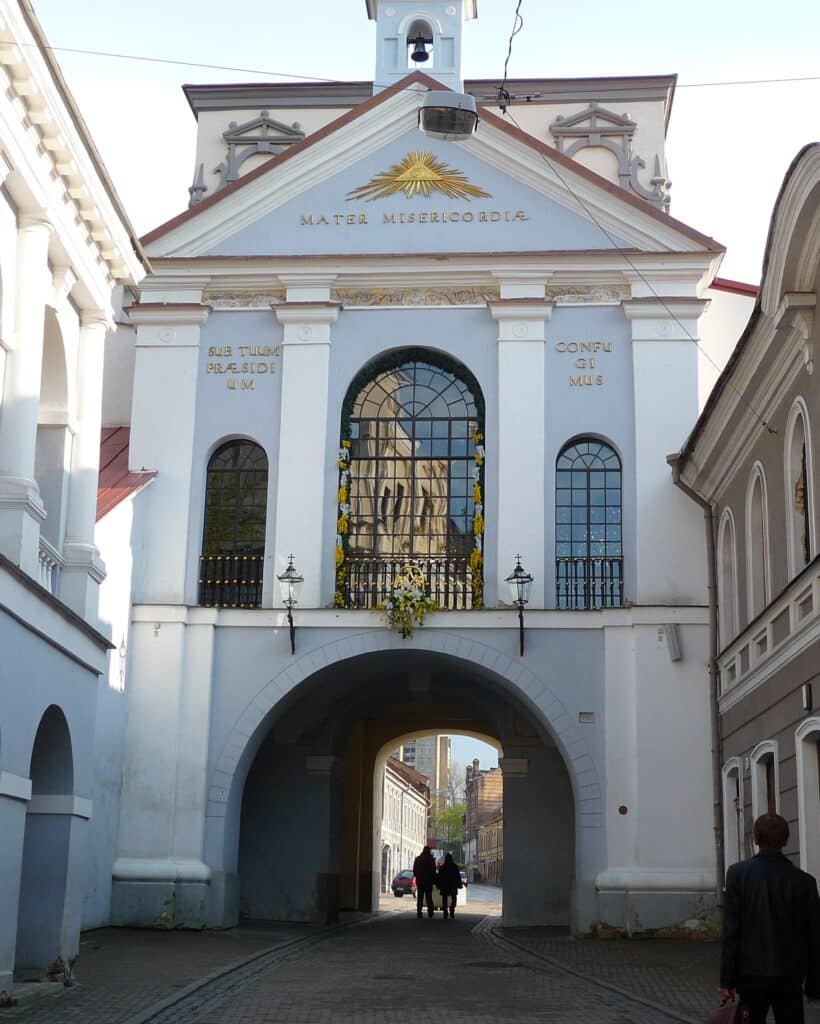
June 7-12, 2026 – Vilnius
The most recent global event on Mercy took place in June in Vilnius, Lithuania. It was organized by the Catholic Diocese of Vilnius and the Vatican’s Dicastery for Evangelization, Section 1. It was presided over by Archbishop Gintaras Grusas of Vilnius, President of the European Bishops’ Conferences. Delegations from around the world were in attendance.
John Paul II called on the Church to be more conscious of and motivated by on Mercy in all its mission. In response to this call, WACOMs are organized regularly every 3 years on different continents.
The conference was marked by the ecumenical dimension on Mercy. Patriarch Bartholomew of Constantinople was in attendance and delivered a keynote address.

“Dives in misericordia” – 1979
With this encyclical letter “God rich in mercy”, Pope John Paul II invites the whole Church to rediscover God’s mercy, particularly through Hebrew terms rich in depth and vibration.
He invites Catholics to be more aware of this and more motivated in all their missions.
“Misericordiae Vultus” – 2015
With this document “The Face of Mercy”, Pope Francis introduces the Jubilee Year of Mercy, pointing out the impact of mercy for world peace. He institutes Missionaries of on Mercy to send them out into the world, so that they may become signs of the Church’s tenderness towards all God’s people, and instruments of reconciliation for the world.
“Misericordia et misera – 2016
With this document “Mercy and Misery”, Pope Francis concludes the Jubilee Year of Mercy with a strong impetus for the future. Sundays the Word of God (late January) and of the Poor (mid-November) will be important milestones in this process.
“Fratelli tutti” – 2020
With the encyclical “Fratelli tutti” (October 3, 2020), Pope Francis invites us to rely on mercy to advance human brotherhood (cf. paragraphs 56, 83, 227, 247, 254 and 285).
“Dilexit nos – 2024
With his encyclical “He Loved Us”, Pope Francis reminds us that merciful love has taken on a face in the world, and that it is in a heart-to-heart relationship that it is manifested in Christ. In a liquid world, rediscovering the heart of God and our own hearts is once again fundamental to living our humanity.
“Dilexi te – 2025
With this exhortation “I have loved you”, Pope Leo XIV wrote the second part of Francis’ encyclical. Because He has loved us, we are called to love our contemporaries, starting with the most vulnerable. The Church, which encourages social works, is led to become a sign of the Lord’s merciful love.
“Address by Pope Leo XIV to Representatives of Civil Society in Algiers” – April 13, 2026
In his address to representatives of civil society in Algiers, Pope Leo XIV points the way toward serving human fraternity by drawing on sources of religious inspiration. He proposes a social doctrine of fraternity.
Other manifestos are currently being drafted.
The answer!
The answer!


